
The Rise of Agentic Commerce and What It Means for Retailers

Summary
AI agents are reshaping how consumers discover and buy products, making agentic commerce the next significant evolution in retail.
Structured, enriched, and machine-readable product data, backed by real-time fulfillment visibility, is essential for AI-driven discoverability.
API-first systems and intelligent order management are now critical to seamlessly connecting products, inventory, and fulfillment for agents.
The rise of AI agents in commerce
You may have heard someone ask something like: “Hey ChatGPT, what phone should I buy?” or seen your Google Search Generative Experience suggest an item before you even finish typing. AI assistants are quietly becoming shopping intermediaries—evaluating products, comparing delivery options, and executing purchases on your behalf.
These agents are starting to replace traditional browsing and checkout flows. They ask for your preferences, scan across channels, weigh stock and shipping, and can act when conditions are right. This marks the dawn of agentic commerce, where autonomous or semi-autonomous systems mediate the relationship between customers and brands.
This isn’t science fiction; it’s already happening. In fact, according to a recent survey, nearly 60% of U.S. consumers are using AI on some level to help them with their shopping and product decision-making.
Here’s everything you need to know right now as an e-commerce brand leader about how agentic commerce works, why it can be a game-changer for your business, and what capabilities you need to become agent-ready.
What is agentic commerce, exactly?
Agentic commerce is when autonomous or semi-autonomous AI agents handle or assist major parts of the purchasing journey on behalf of the user/shopper.
These agents:
- Evaluate options based on context and user preference (e.g., size, brand loyalty).
- Compare prices, delivery times, loyalty benefits, and return policies to optimize for ideal outcomes.
- Operate across platforms and APIs—they are not confined to one website or storefront.
For instance:
- A shopping agent that knows you want a high-end camera under $1,000 finds the best price across retailers, checks shipping times, applies your loyalty discount, and orders from the fastest source the moment it becomes available or hits your goal price.
- A personal AI assistant remembers your child’s shoe size and style, monitors inventory, and automatically reorders when stock drops or a new variant is launched.
Where traditional e-commerce flows involve a shopper browsing a site, adding to cart, and checking out, agentic commerce flips the script: the agent becomes the intermediary between your brand and the buyer. So your systems must be ready to respond to these agents.
According to an Adobe survey, 39% of consumers say they’ve used generative AI for online shopping, and 53% plan to do so in 2025. Additionally, another survey found that 43% of Americans are aware of AI shopping assistants, but only 14% have used one, highlighting the juvenile stage of this shift and the opportunity to be an early adopter.
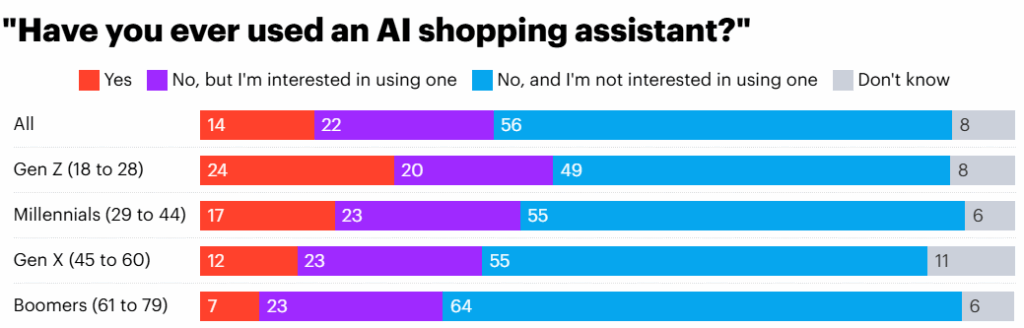
Source: YouGov
Why this changes everything for e-commerce brands
If you’re leading retail operations, marketing, or e-commerce at a company, you’re already facing a shift in the landscape:
- Discovery is no longer limited to your website. AI shopping agents can search, compare, and recommend your products before the customer even lands on your homepage.
- Clicks may no longer be the conversion metric. In many instances, orders will trigger via APIs—agent to brand—instead of the shopper adding to their carts and checking out.
- Your product data must be machine-ready. If your attributes, inventory, pricing, and fulfillment logic aren’t optimized for deep, structured consumption, your products won’t appear when the agents act.
This is where AI discoverability and fulfillment orchestration become crucial. Being agent-ready may soon be as essential as being mobile-ready was a decade ago.
To thrive in this era, you’ll need to:
- Ensure your product catalog uses rich, consistent metadata and schema markup effectively.
- Adopt an orchestration layer to route, reserve, fulfill, and return orders from any channel or node.
- Embed real-time, machine-accessible fulfillment data so agents can confidently execute decisions.
How AI agents make shopping decisions
AI agents don’t shop the same way humans do; they don’t scroll through a site for inspiration or rely on assumptions. They evaluate based on data, logic, and structured signals, and your brand must prepare accordingly:
- Product attributes
- Agents assess structured data attributes like size, brand, SKU, variant, material, age range, etc.
- They rely on schema markup and contextual metadata to filter and match the precise needs of their users.
- For instance, an agent targeting a camera will prioritize high-resolution specs, sensor size, shipping bundles, and lens compatibility over generic promotional blurbs.
- Pricing and promotions
- Agents compare real-time pricing, discounts, loyalty points, bundling incentives, and shipping cost trade-offs.
- If your system adds a “10% loyalty discount” or “free shipping today” attribute, your product becomes more agent-friendly.
- A study revealed that 25% of the changes significantly boosted market share when sellers tweaked descriptions targeting algorithmic buyers.
- Fulfillment
- Agents evaluate inventory availability, delivery estimates, fulfillment node location, purchase-to-door time, split-shipment risk, and return readiness.
- A machine-readable attribute like “ships within 24 hours from store X” or “prefers no 3PL delay” will boost your agent visibility.
- If agents detect a mismatch (e.g., the catalog says “in stock” but actual fulfillment lags), your product may be deprioritized.
- Trust and policies
- Agents filter for reliability signals, such as merchant rating, past fulfillment accuracy, warranty/return policy clarity, product authenticity, review count, and quality.
- The better your agent-readable trust footprint is, the more likely your product will surface.
- For example, ensuring the schema includes “free 30-day returns,” “2-year warranty,” or “4.8+ rating from verified buyers” improves the decision-path.
You risk missing out if you only treat your backend like a human-facing catalog. Agents ignore visuals and banners—they strictly read data. So you need to make sure:
- Your product data is enriched, accurate, structured, and channel-ready.
- Your fulfillment and inventory systems are up-to-date, transparent, and machine-accessible.
- Your trust signals (reviews, ratings, policies) are clean, accessible, and verifiable.
Key capabilities to support agentic commerce
Here’s a structured checklist of the key capabilities you should consider investing in to become agent-ready, powered by an effective agentic commerce platform.
- Product-data capabilities
- Product data must include enriched descriptions, complete technical specifications, and contextual metadata that both humans and machines can interpret.
- Attributes like size, material, variant, and usage scenario can help your AI agents understand relevance and intent.
- Implementing schema.org markup on product and category pages makes product information more visible and accessible to AI Search and AI discovery engines.
- Over 45 million domains now use schema markup, highlighting its growing importance for visibility.
- Visual content must also be optimized for machine interpretation, with high-quality images, clear alt text, accurate labeling, and consistent metadata across every demand channel.
- Supply-chain and fulfillment capabilities
- Real-time inventory visibility and accurate delivery-time estimates across warehouses, stores, and 3PL partners are essential for agentic orchestration.
- According to U.S. retail studies, inventory inaccuracies can reduce annual sales by about 4%.
- Agents rely on clear and accessible policy data, so ensure return and warranty information like duration, conditions, and expectations is structured and machine-readable through your APIs.
- Intelligent order-routing rules must be in place to enable your AI agents to select the most cost-efficient or fastest fulfillment path automatically.
- This will allow agentic commerce platforms to play a central role by orchestrating orders across every fulfillment node.
- Backend systems and architecture
- You’ll need an API-first architecture where all key modules—product data, inventory, orders, fulfillment, and loyalty—are exposed via endpoints that AI agents can query and act upon in real time.
- A modern order management system integrated with an agentic commerce platform is critical for orchestrating multi-node fulfillment, managing split shipments, and efficiently supporting pre-orders and back-orders.
- Personalization and loyalty logic should be API-exposed, enabling your AI agents to retrieve real-time loyalty status, personalized offers, and rewards information directly without customer intervention.
Start now, because agents don’t wait
Agentic commerce is already reshaping how shoppers discover, decide, and purchase products. Waiting too long can put your products at risk of being undiscoverable when shoppers look for them.
Here’s how you can act now:
- Capture where your catalog, inventory, and shipping information currently stand.
- Identify gaps in machine readability and accessibility by checking if attributes are clearly defined, if schema markup is in place, and if APIs are live and consumable by AI agents.
- Partner with a robust agentic commerce platform to move toward an API-first architecture and ensure real-time orders, inventory, and returns orchestration.
The brands that embrace innovation early will earn the future-first consumer’s trust and wallet share.
Sound overwhelming? It doesn’t have to be. Take our AI Search Assessment today and learn how Product Agent can power your agentic readiness.

Editorial Team
Digital content editorial team @ fabric
Related Content