
Ready. Set. Glow. NRF 2026: Your Call to Action on Agentic Commerce
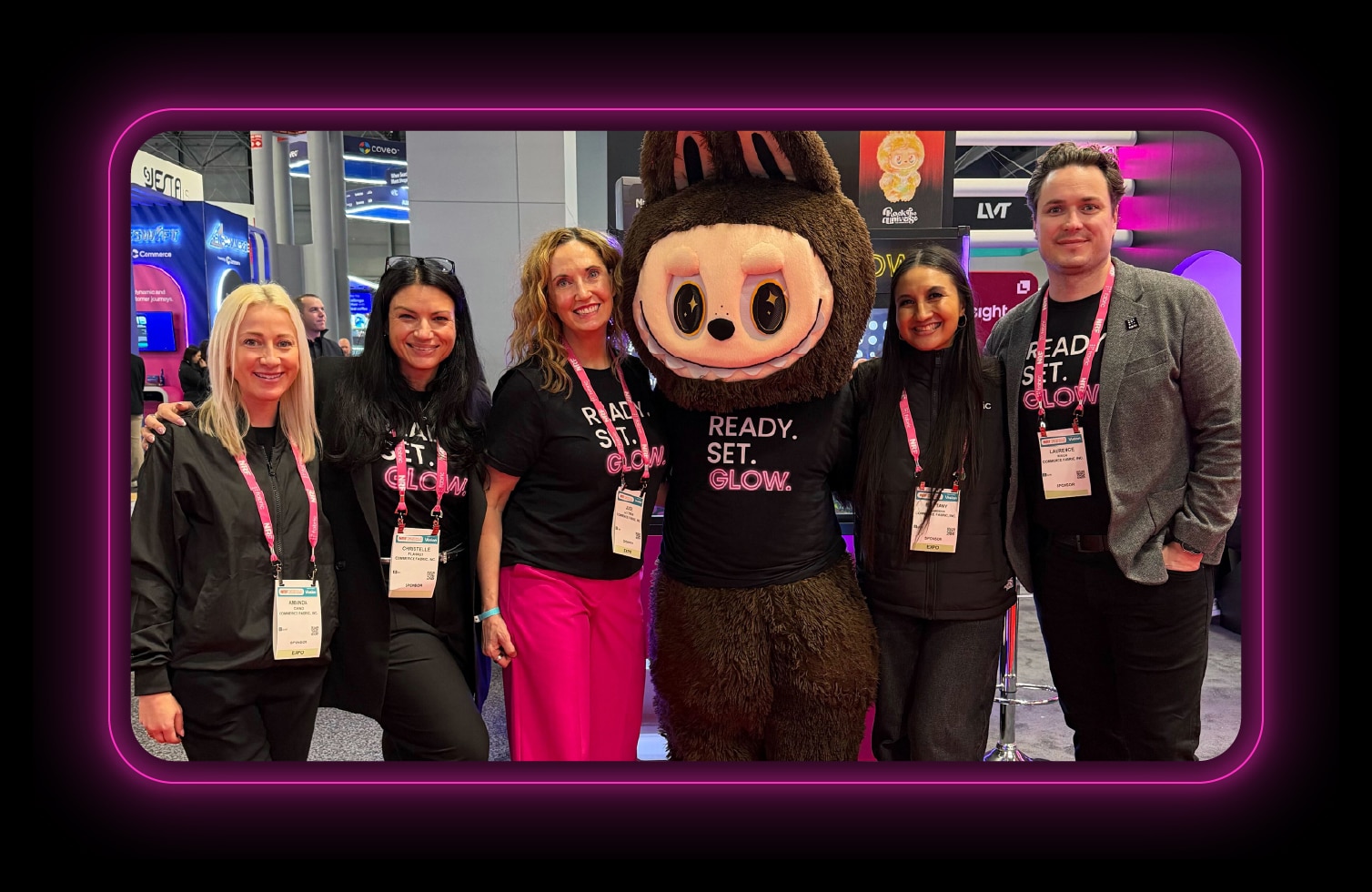
The 2026 NRF Big Show is done and dusted, and, while we’re all catching our breath, the key takeaway is that agentic commerce waits for no person. The resounding messaging from every corner of the Javits Center is that AI has fundamentally changed e-commerce, and it’s up to you to figure out how to adapt fast and capture the moment. I’ve compiled my thoughts on what this means for brands and retailers and how to think about the year ahead with some actionable insights. Let’s go!
The paradigm shift: the AI conversation shifts from driving efficiency to capturing demand
At the 2025 NRF Big Show, the narrative in retail tech was all about the opportunity AI provided for operational efficiency. Much of the exhibit hall focused on mining every ounce of performance from existing operations and technology. The AI use cases centered on AI for personalization, chatbots for conversational commerce, automation of routine tasks, and LLMs for accelerated content generation, to name a few. At fabric, we spent much of 2025 testing use cases around AI for supply chain optimization and product onboarding, exploring how predictive models could tighten time to market, new SKUs, and improve the delivery of brand promise.
But something important had already happened quietly beneath the surface.
The moment AI became the shopping interface
A month before NRF 2025, Perplexity launched Buy with Pro, a first-of-its-kind e-commerce feature that enabled users to discover products and complete purchases directly within an AI search experience. The agentic commerce concept was born, and it kicked off the arms race between Perplexity, OpenAI, Amazon, Google, and Microsoft to envision a new shopping experience.
This arms race wasn’t simply a new gadget or experiment. It marked a breakpoint: AI was beginning to move from assistant to agent, acting on users’ behalf to surface relevant products within answers.
I watched as this concept went from being thought of as a wacky experiment that would happen “one day” to a mature concept inclusive of technical protocols, committed vendors, and major retailers signing up (Walmart, Etsy, Target, Shopify, and Instacart). All of this took place over the past 12 months. Only six months ago, at CommerceNext, this remained purely hypothetical. Well, what a difference six months makes in this AI era.
The widespread adoption of AI Search for product research and discovery meant shoppers were no longer clicking through dozens of tabs; they were asking conversational queries and getting curated product lists instantly.
By the tail end of the year, sentiment and behavior shifted unmistakably as AI influenced purchase decisions at scale. Consumers increasingly used generative AI not just to find inspiration but to plan and decide purchases, shifting where and how brands could be discovered.
Naturally, this sparked a question that nearly every retailer was wrestling with by NRF 2026:
“How do I ensure my products are discoverable, and purchasable, on these emerging agentic channels?”
The market pulse: AI to drive agentic commerce strategy
Walking the show floor in New York felt less like an evolution and more like a pivot. AI wasn’t just another tool. It was embedded into nearly every conversation, demo, and product announcement. From platforms to payments, incumbents and startups positioned themselves for what many now recognize as the agentic commerce era.
This isn’t incremental innovation; it’s a redefinition of the commerce stack itself.
At fabric’s booth, we heard a recurring theme from retail operators and digital leaders:
“Executives want us to leverage AI, but I don’t even know where to start.”
From curiosity to competitive pressure
Behind that sentiment was an undercurrent of FOMO (fear of missing out) on capturing AI-driven discovery — the executive discussion filtering down to operational leaders who need tactics that will underpin an agentic commerce strategy. Teams were eager to discuss experiments and find use cases that could lift product visibility, accelerate conversion, and make sense of what has quickly become a complex, multi-channel AI marketplace.
What’s interesting to see is how the vendor side is positioning to support brands and retailers on their agentic commerce journey. There is a suite of legacy products that sit atop the composable commerce stack, offering their own AI solutions. These incumbents have market share across content management, product enrichment, cart and checkout, and order management. They’re all defining the AI use cases that will give their customers tools to support agentic commerce.
What stuck with me is how this paradigm shift calls for more than bolt-on solutions. It requires a complete rethink of how commerce has been done and where it’s heading. Consider the critical pieces of agentic commerce that call for more nuanced tactics, technology, and services to execute the right way. New standards are being created for how to drive product visibility, new protocols are being aligned on for handling checkout, and new architecture is required to fulfill orders. It will be interesting to see how the broad vendor community adapts in the coming months as ACP and UCP take root. And, more importantly, how the market will pick winners and losers.
At fabric, we’ve built a solution from the ground up for agentic commerce called Product Agent, and it’s exciting to see how brands and retailers reacted to it on the show floor.
Actions for 2026: what retailers must prioritize
The shift to agentic commerce isn’t merely conceptual; it demands practical action. Here’s what forward-looking companies should be prioritizing in 2026 to stay competitive:
1. Understand visibility: beyond brand awareness
There’s a lot of attention on whether your brand is visible to agents. But, in agentic commerce, product visibility is king.
The days of short keyword or brand searches are dead. It’s imperative to understand that customers using AI for product discovery are starting with broad, context-rich use cases such as “Best running shoes under $120 for long-distance trail running in the Pacific Northwest.” Your priority must be to understand whether your products are visible within the context of strategic customer prompts. Brand mentions in AI Overviews or ChatGPT answers are not actionable and won’t drive true product match.
This means you need to be evaluating machine-readability, structured data presence, and how product content appears in AI-generated shopping responses.
And, aha, fabric has a solution for you to monitor product visibility.
2. Optimize product data: your most valuable IP
As our CEO, Mike Micucci, often says, “your product data is your IP in the agentic commerce era.” It’s no longer sufficient to have sparse product data, titles, and a listed price. AI agents thrive on rich, contextual data.
Invest in deep attributes, comprehensive keyword coverage, clear FAQs, and descriptive image alt text. Wrap your products in the semantic and category-specific context that AI agents crave. The better your product content communicates, not just to humans, but to machines, the higher your chances become of being discovered and recommended during product research.
This isn’t optional; it’s foundational for visibility and conversion in agentic commerce channels.
Once again, fabric has a solution for you to activate better product data.
3. Plan for ACP & UCP: the new protocols of commerce
Two standards launched in 2025 and at NRF 2026 are now shaping the future of agentic commerce:
- Agentic Commerce Protocol (ACP): A standard developed by Stripe and OpenAI to enable AI agents to perform checkout and purchase actions within ChatGPT.
- Universal Commerce Protocol (UCP): Announced by Google and co-developed with Shopify and others, UCP creates a common language allowing AI agents to discover products, manage carts, and complete transactions without custom point-to-point integrations across the full commerce journey.
But participation isn’t a switch you flip lightly. Enabling these protocols effectively introduces new commerce channels that pose demands on supply chain readiness, customer service, and brand experience. If an AI agent surfaces your products and captures demand you weren’t prepared to fulfill, it can damage customer trust before you truly begin.
Approach this decision thoughtfully:
- Understand how ACP and UCP integrate with your existing systems.
- Evaluate whether your backend, fulfillment, and returns infrastructure can support new demand vectors.
- Forecast potential uplift, associated costs, and plan capacity accordingly.
Viewed strategically, embracing these protocols is more than channel expansion. It’s an opportunity to experiment with agentic commerce while building predictive demand forecasts that will inform your long-term strategy.
Final thoughts: the new way to commerce is here, are you ready?
The shift we’re witnessing isn’t just another technology trend. It’s a platform shift, akin to the rise of mobile commerce or social marketplaces. The tools, standards, and behaviors of 2026 bear little resemblance to those of a decade ago.
Agentic commerce doesn’t replace human shoppers. Instead, it empowers agents acting on behalf of humans to discover, evaluate, and execute commerce with intention and autonomy. To thrive here, retailers must think structurally, invest in machine-ready data, and embrace emerging protocols shaping how digital agents interact with their products.
The question is no longer if agentic commerce will matter — it’s how fast you can adapt.

Laurence Nixon
Director, Product Marketing @ fabric
Related Content