What is an Agentic Commerce Platform? Autonomous Retail Guide

Summary
Agentic commerce has a consumer side, where AI agents shop, and a retailer side, where an agentic commerce platform makes your catalog and signals easy for those agents to understand and recommend.
AI agents can only surface products that they can interpret, so incomplete attributes, inconsistent taxonomy, or outdated availability can make even strong products effectively invisible in AI-driven discovery.
Manual catalog cleanup is not efficient for scaling, so using AI agents to enrich, standardize, and keep product data current can help you maintain discoverability.
Agentic commerce has two sides:
- Consumer AI agents that shop autonomously, such as ChatGPT and Perplexity as shopping assistants.
- Retailer-side infrastructure that makes your catalog, availability, and policies agent-ready.
AI agents can’t confidently recommend what they can’t interpret. If your product data is incomplete (missing attributes), inconsistent (messy taxonomy), or outdated (availability/fulfillment signals), your products risk becoming invisible or worse, being confidently misinterpreted.
An AP-NORC poll reported that about 26% of US adults use AI for shopping, highlighting that discovery is shifting upstream of the storefront.
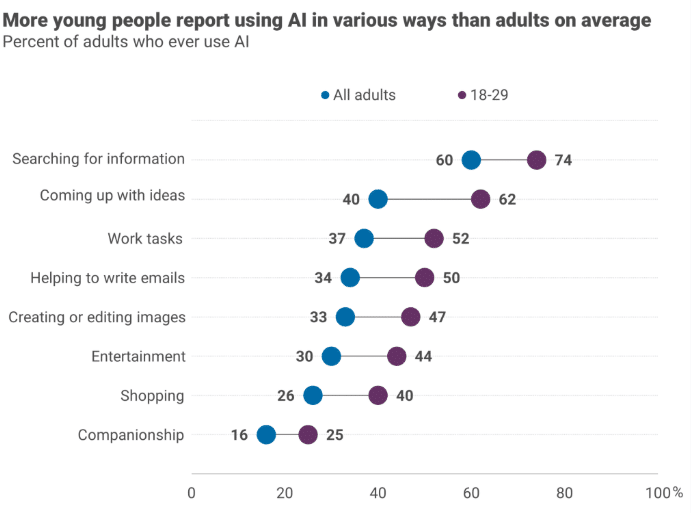
Source: AP-NORC
In this article, we’ll review what an agentic commerce platform is and how it deploys AI agents to continuously improve how your products are understood, surfaced, and trusted through AI-driven discovery.
Agentic commerce platforms vs. AI shopping agents
Most agentic commerce layers focus on the consumer side, such as AI shopping agents like ChatGPT-style shopping or Amazon’s Buy for Me features that help shoppers discover and purchase products.
However, the layer on the retailer side is what determines whether those agents can actually find, understand, and confidently recommend your products in the first place.
| AI shopping agents | Agentic commerce |
| Discover options, compare, and complete purchases.Optimize for the shopper’s goals: price, availability, speed, fit, trust. | Make your catalog agent-readable.Keep inventory and product facts up to date in real time.Ensure agents can access the right information to make recommendations. |
Mobile commerce didn’t replace e-commerce; it simply forced retailers to adapt and build mobile-friendly experiences. Similarly, agentic commerce is introducing a new requirement: agent-ready infrastructure that requires clean product data, reliable signals, and channel activation.
fabric NEON is an advanced AI-powered agentic commerce platform that can help your brand get discovered in an AI-led shopping flow by improving catalog readiness, visibility, and activation.
Why retailers need agentic commerce platforms now
AI search is replacing traditional product discovery
AI-powered shopping is shaping how shoppers research products before they even reach the product page.
AI agents and answering engines have now become the shortcut to browsing. Instead of using the traditional search filters, shoppers ask a question and expect a short list of best matches.
A structured, attribute-rich listing beats vague marketing copy when an AI system has to decide what to recommend. When key fields are missing or inconsistent, agents can’t confidently match products to specific prompts, which can surface other products and effectively render your products invisible.
Manual product management doesn’t scale
Catalogs can range from thousands to tens of thousands of SKUs, and each SKU may require consistent attributes to support detailed queries (size, material, compatibility, use case).
For instance,
- 10,000 products x 5 minutes each = 50,000 minutes
- 50,000 minutes / 60 = 833 hours
- At an average loaded cost of $25 per hour, that’s approximately $20,825 of your team’s time before QA, rework, and ongoing changes.
By the time a manual clean-up sprint ends, the catalog has already changed (new supplier files, new variants, new policies, new channels). fabric NEON continuously improves product discoverability for agentic commerce, so your product catalog stays up to date as the environment shifts.
Core capabilities of an agentic commerce platform
Automated product data enrichment
AI agents:
- Extract attributes from supplier feeds, existing descriptions, and imagery (where available), and standardize them into consistent fields.
- Standardize taxonomy so categories/attributes mean the same thing across the entire catalog.
- Fill missing fields (e.g., materials, dimensions, compatibility) using validated sources and rules you control.
- Source data quality continuously, so gaps don’t quietly creep back in as new SKUs arrive or suppliers change formats.
AI shopping focuses on specific, attribute-rich product data rather than vague marketing copy. If “waterproof”, “width”, “material”, “fit”, or “use case” isn’t captured consistently, AI agents would struggle to match your products to conversational queries and filters.
AI search optimization (Answer engine optimization)
While traditional SEOs optimize pages for keyword-based ranking, AEO/GEO optimize structured product facts so AI systems can confidently interpret, compare, and cite your products in answers.
AI agents can automate:
- Product structured data alignment, ensuring pricing, availability identifiers, and key attributes are consistently represented in ways machines can parse.
- Relationship mapping to help machines understand how products connect (alternatives, complements, variations), which supports better recommendations and comparisons.
- Visibility monitoring across AI surfaces to track prompts, rankings, and content depth, and recommend fixes where your products lose ground.
When agents need to cite a product, they tend to prefer clear, factual, structured information (what it is, what it’s compatible with, whether it’s in stock, what it costs) over marketing copy.
Real-time inventory and catalog visibility
AI agents need to know what’s exactly purchasable (including variant-level availability), especially when they’re narrowing results in real time.
AI agents support:
- Synchronized visibility across channels and sources (owned stock and third-party inventory), so availability signals stay consistent.
- API-first access to ensure approved systems can pull the same product information and availability without requiring manual exports.
- Unified catalog across all sales channels to ensure that the product displays the same information everywhere it appears.
How agentic commerce platforms integrate with existing systems
You don’t have to rip out your existing Shopify, BigCommerce, or Adobe environment to get agent-ready. An agentic commerce platform can sit alongside your current stack as an agentic-access layer so you can add new capabilities without a risky migration.
- Your existing commerce platform continues to run orders, checkout, and customer data.
- Your team can keep working in familiar tools and workflows.
- Your day-to-day operations are not disrupted.
Changes brought forth by the integration:
- AI agents continuously improve the quality of your product data, making your catalog easier for AI shopping agents to understand and recommend.
- Enrichment runs as an always-on workflow, and not just a one-time clean-up task.
- AI-search visibility becomes something you can monitor and maintain like a performance channel.
For instance,
- Your Shopify Plus remains the transaction layer (checkouts, orders, customer records).
- fabric Product Agent uses AI to enrich and optimize product data for agent-led discovery and AI search.
- Real-time APIs keep product and availability updates aligned, so AI agents can access reliable, up-to-date information.
The U.S. Census Bureau’s estimate of US retail e-commerce sales for Q3 2025 was about $310.3 billion, representing 16.4% of total retail sales, highlighting the importance of improving discoverability without disrupting revenue-critical systems.

Source: U.S. Census Bureau
Use cases: What agentic commerce platforms enable
Making catalogs discoverable to AI shopping agents
If a shopper asks ChatGPT: “Find me sustainable yoga pants under $50 in size medium,” the agent looks for machine-readable fields such as:
- Materials (e.g., recycled polyester)
- Price (≤ $50)
- Size availability (M in real-time stock)
- Fit, inseam, color, certifications, care instructions
Products with missing/unclear fields don’t surface (even if they’re a better fit). Products with complete attributes get shortlisted and recommended.
An agentic commerce platform enables:
- Automated enrichment to ensure each SKU has complete, consistent attributes.
- A repeatable product data record that’s ready for agent-led discovery.
- Continuous monitoring of where your products show up across answer engines.
Supporting complex product portfolios
Once you start selling among a mix of owned brands, third-party products, and dropship inventory, agent-readiness can become challenging, involving:
- Multiple data sources (suppliers, internal systems, channel exports).
- Different naming conventions and attribute completeness.
- Inconsistent taxonomy (same product type labeled differently in each channel).
An agentic commerce platform enables:
- One interface to standardize taxonomy and normalize attributes across all product types.
- Faster onboarding and structured supplier data mapping.
- Channel-specific activation so that each demand channel gets the fields it relies on most.
Adapting to evolving agent requirements
Agent experiences are a moving target; new shopping surfaces emerge, and existing ones evolve. Agents become stricter about trust signals such as availability, delivery promise, returns, warranty, and clear specs because bad recommendations damage their credibility.
An agentic commerce platform enables:
- Ongoing monitoring of visibility by prompt/category, allowing you to see what’s happening.
- Automated enrichment and iteration loops, so you’re not doing quarterly catalog clean-up projects just to stay eligible for recommendations.
- A practical starting point via an AI Search Assessment to evaluate the agentic readiness of your product catalog.
Measuring success with agentic commerce platforms
Measure the impact by focusing on:
- AI search visibility to measure how often your products are cited or surfaced in AI answers or shopping workflows, and reviewed by category or query type.
- Catalog completeness to identify the share of SKUs that have the attributes agents need to match intent reliability, including size, material, compatibility, and price.
- Time savings to measure the reduction in manual hours spent fixing supplier files, filling gaps, and normalizing taxonomy as enrichment runs continuously.
- Agent-driven revenue to measure the sessions and conversions that originate from AI assistants and agentic referral paths.
Set a realistic timeline:
- Within 30 days, you should see measurable lifts in attribute coverage and fewer manual cleanup hours as automation runs consistently.
- Within 60 to 90 days, you should see visibility gains as improved data quality propagates and is reflected in AI-facing surfaces.
- After 6 months, you can treat agent-driven traffic and conversions as a trackable channel once attribution and reporting are stable across journeys.
Aim to reduce manual product data work by 70–90% once enrichment and monitoring run continuously and the catalog quality score is stable.
The future: From AI-ready to AI-native retail
Many retailers are gradually adapting their product pages and structuring their data so their catalogs appear in AI search results.
As consumer agents continue to take on more of the browsing, comparing, and shortlisting over the next 12 to 18 months, agent-driven transactions will increase relative to traditional website traffic.
Reliable agentic commerce platforms like fabric can help you shift to the future-proof, essential infrastructure.
If your catalog is not agent-ready, your products risk becoming invisible in the interfaces where shoppers ask questions and make decisions.
Contact us today to evaluate your current visibility in AI engines and identify the optimization opportunities you can act on next.

Editorial Team
Digital content editorial team @ fabric
Related Content