
The New Rules of Search: What are the Differences Between SEO vs. AEO?
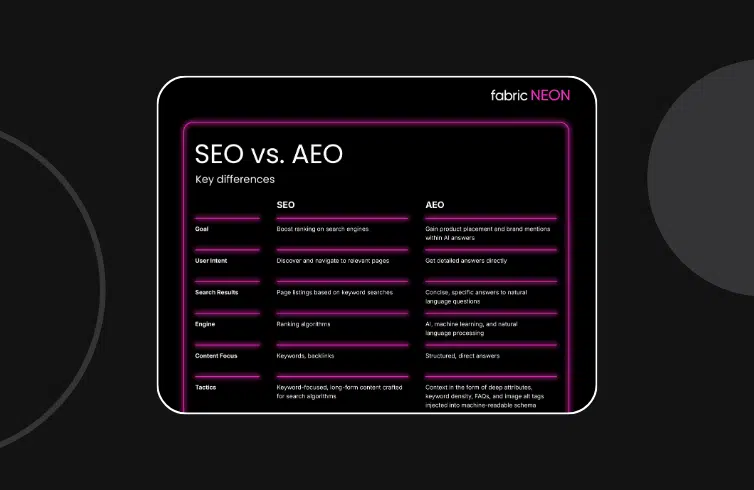
As more shoppers turn to AI assistants—not traditional search bars—to find products and answers, the way brands get discovered is rapidly changing. Search engine optimization (SEO) isn’t disappearing, but “answer engine optimization” (AEO) is emerging as the next layer of visibility. While SEO relies heavily on keyword strategy, AEO requires deeper, richer content that AI systems can interpret and distill into direct answers.
This shift has major implications for how product information should be written, structured, and delivered. Below, we break down the main differences between SEO and AEO, explain why AEO matters now, and outline the tactics that help brands surface inside AI-generated responses.
Goal
SEO traditionally aims to help pages rise in search results. The main objective is simple: get your site to appear near the top of a list of blue links.
AEO, however, has a more modern goal: to ensure your brand or product is included directly in AI-generated answers. Instead of fighting for a click, you’re working to appear inside the response itself, whether it’s delivered by a chatbot, a voice assistant, or another AI interface.
User intent
With SEO, the expectation is that users want to browse. They search, scan results, and choose which site to open.
With AEO, shoppers expect immediate, specific answers. They aren’t looking to sift through pages. They want a direct, trustworthy response that already includes the product details they need.
Search results
In SEO, the outcome is a ranked list of pages based on keyword relevance.
In AEO, results come back as concise summaries, recommendations, or explanations. The AI combines facts, features, and context from multiple sources and presents them as a single, natural-language answer.
Engine behind the results
SEO is built on ranking algorithms that prioritize keywords, metadata, link structure, and page performance.
AEO relies on AI models that understand language, evaluate sentiment, recognize context, and interpret more complex content types such as videos, datasets, and structured attributes. These models behave less like indexing bots and more like human readers.
Content focus
Traditional SEO revolves around keyword placement and linking strategy. Writers often stretch content to hit target word counts or ensure keyword density.
AEO flips this model. It rewards clear, structured, in-depth information—details that help AI confidently extract and reassemble answers. Instead of stuffing keywords, brands need to provide information that is accurate, straightforward, and highly descriptive.
Tactics
SEO is often about crafting long, keyword-dense content that follows search engine rules.
AEO requires a different approach. Helpful AEO tactics include:
- Answering common shopper questions through FAQ sections
- Targeting conversational queries, including long-tail questions
- Writing naturally, using phrasing similar to the way people talk to chatbots and voice assistants
- Offering direct, specific explanations instead of fluffy or padded text
- Using schema markup to structure information so AI systems can easily identify attributes and meaning
These tactics help AI extract accurate product details and include your brand in its summaries.
Key metrics
SEO performance is often tracked through metrics like organic sessions, which is how many visitors land on your site from search engines.
AEO success is measured differently, typically by impressions inside AI-generated answers or how often your product appears in featured snippets, summaries, or recommended lists.
Why AEO matters now
SEO isn’t going away, but it no longer reflects how people actually search. Modern shoppers increasingly ask natural-language questions:
- “What’s the best watch for everyday wear?”
- “Which moisturizer works for sensitive skin?”
- “Show me comfortable shoes for standing all day.”
AI can understand these prompts in context, interpret nuances, and deliver a digestible answer—often without showing a list of websites. To appear in these results, brands need to go beyond keywords and offer deeply enriched content that AI can confidently use.
Beyond that, AI systems can parse more complex types of content that traditional crawlers struggled with, such as videos, dynamic elements, or structured data. Because AI can understand sentiment and context, it no longer needs long word counts or repeated terms to figure out what a page means.
In short, quality and clarity now matter more than quantity.
AEO tactics every brand should start using
Here are the core AEO tactics that consistently help brands appear in AI-driven summaries:
1. Build rich, detailed product descriptions
Include attributes like materials, dimensions, use cases, category, movement type, or care instructions. The more specific and factual you are, the easier it is for AI to match your product to user intent.
2. Add FAQs that match real shopper questions
Shoppers often phrase questions conversationally. Adding a short, focused FAQ section helps AI quickly pull answers.
3. Write naturally, not mechanically
AI favors content that reads the way people speak. Overly optimized SEO copy tends to feel repetitive or inflated. It’s recommended to avoid this style.
4. Structure content using schema
Implement structured data so AI can easily identify product attributes, ingredients, specifications, and benefits.
5. Target long-tail and question-based queries
Instead of “best men’s watch,” think in terms of real-life queries like:
- “What men’s watch works well for both office and casual wear?”
- “Is a sapphire crystal watch durable?”
6. Give clear, complete answers
Avoid vague claims. Use straightforward descriptions that help AI confidently understand your product’s value.
The bigger picture
AEO isn’t just another optimization checklist. It reflects how search is fundamentally changing. As AI interfaces become the primary discovery tool for shoppers, brands must adapt to ensure their products are represented accurately and prominently.
The good news: the enriched content required for AEO doesn’t just support AI search. It also strengthens visibility across every discovery channel, including traditional SEO.
But relying on legacy SEO tools won’t be enough. Brands need modern capabilities built for agentic search environments. fabric Product Agent helps teams do exactly that by automatically structuring, enriching, and maintaining product data in a way AI systems can easily understand. It streamlines the creation of detailed attributes, descriptions, and schema so products consistently surface in AI-generated answers and recommendations.
Ready to get ahead in the age of AI answer engines?
Download The Agentic Commerce Playbook: Volume 1 to get the full insights on how to optimize for AEO and learn how AI is reshaping discovery. Additionally, take our AI Search Assessment to see how you show up in answer engines and to secure early access to Volumes 2 and 3!

Editorial Team
Digital content editorial team @ fabric
Related Content